Pick to Light vs Barcode Scanning: Which Is Better for Your Warehouse?
As warehouses look to improve picking efficiency and accuracy, two of the most commonly used technologies are pick to light (PTL) and barcode scanning.
Both solutions are widely adopted across industries, but they serve different operational needs. Choosing the right one depends on your warehouse size, order volume, SKU complexity, and workflow.
We will compare pick to light and barcode scanning to help you determine which solution is best for your warehouse.
What Is Pick to Light?
Pick to light (PTL) is a visual picking system that uses LED indicators and digital displays or e-ink displays installed on shelves or racks.
When an order is released:
● Lights illuminate at the correct picking locations
● The display shows the quantity to pick
● Operators confirm the action by pressing a button
This system minimizes search time and reduces human error.
What Is Barcode Scanning?
Barcode scanning is a traditional warehouse picking method that uses handheld scanners or mobile devices.
Operators:
● Scan item barcodes
● Verify product information
● Confirm picking tasks through the system
It is widely used due to its flexibility and relatively low implementation cost.
Pick to Light vs Barcode Scanning: Key Differences
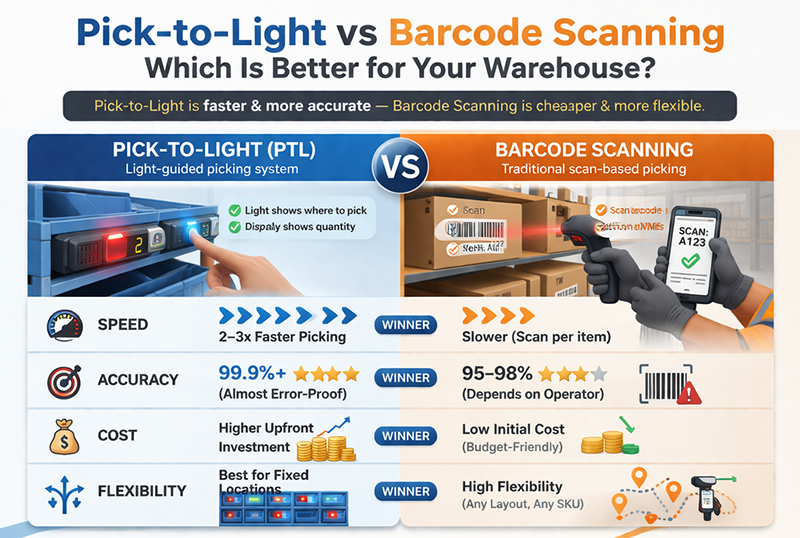
Pick to Light | Barcode Scanning | |
| Picking Speed | Significantly faster due to visual guidance and reduced search time. | Slower, as each item must be scanned individually. |
Picking Accuracy | Can achieve up to 99%+ accuracy in structured environments. | Accuracy depends on operator discipline and scanning consistency. |
| Labor Efficiency | Reduces training time and operator fatigue. | Requires more manual steps and experienced workers. |
| Implementation Cost | Higher upfront investment (hardware + setup). | Lower initial cost, easier to deploy. |
| Flexibility | Best suited for fixed picking locations and structured workflows. | Highly flexible, suitable for dynamic storage environments. |
When to Choose Pick to Light / Barcode Scanning?
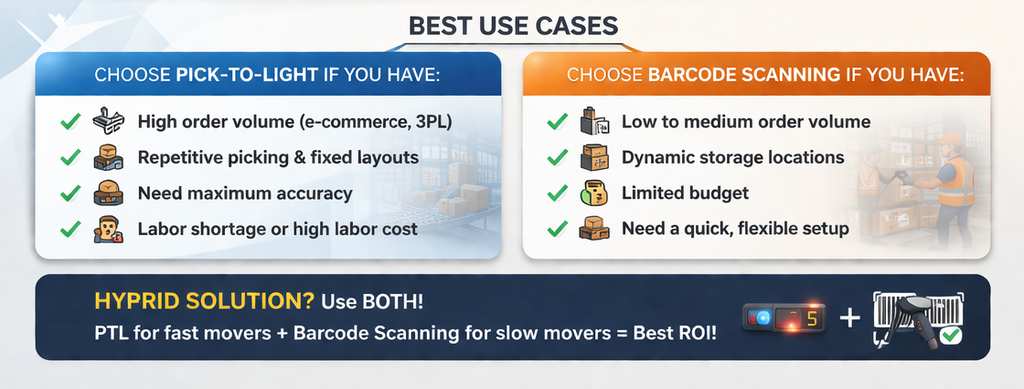
| When to Choose Pick to Light | When to Choose Barcode Scanning |
| Pick to light is ideal if your warehouse: 1. Handles high order volumes
2. Has repetitive picking processes 3. Requires high accuracy (e.g., e-commerce, pharmaceuticals) 4. Needs to reduce labor dependency
5. Operates with fixed picking zones | Barcode scanning is a better choice if your warehouse:
1. Has a limited budget
2. Manages low to medium order volumes
3. Uses dynamic storage locations
4. Requires high flexibility
5. Is in early-stage automation |
There is no one-size-fits-all answer when comparing pick to light and barcode scanning.
If your priority is speed, accuracy, and efficiency, pick to light is the better option.
If your priority is cost and flexibility, barcode scanning remains a reliable choice.
For many warehouses, a hybrid solution delivers the best overall performance.
If you're evaluating which system fits your warehouse, feel free to contact us: 📧 sales@sertag.com
We can help you design a tailored solution based on your workflow, SKU structure, and growth plans.